
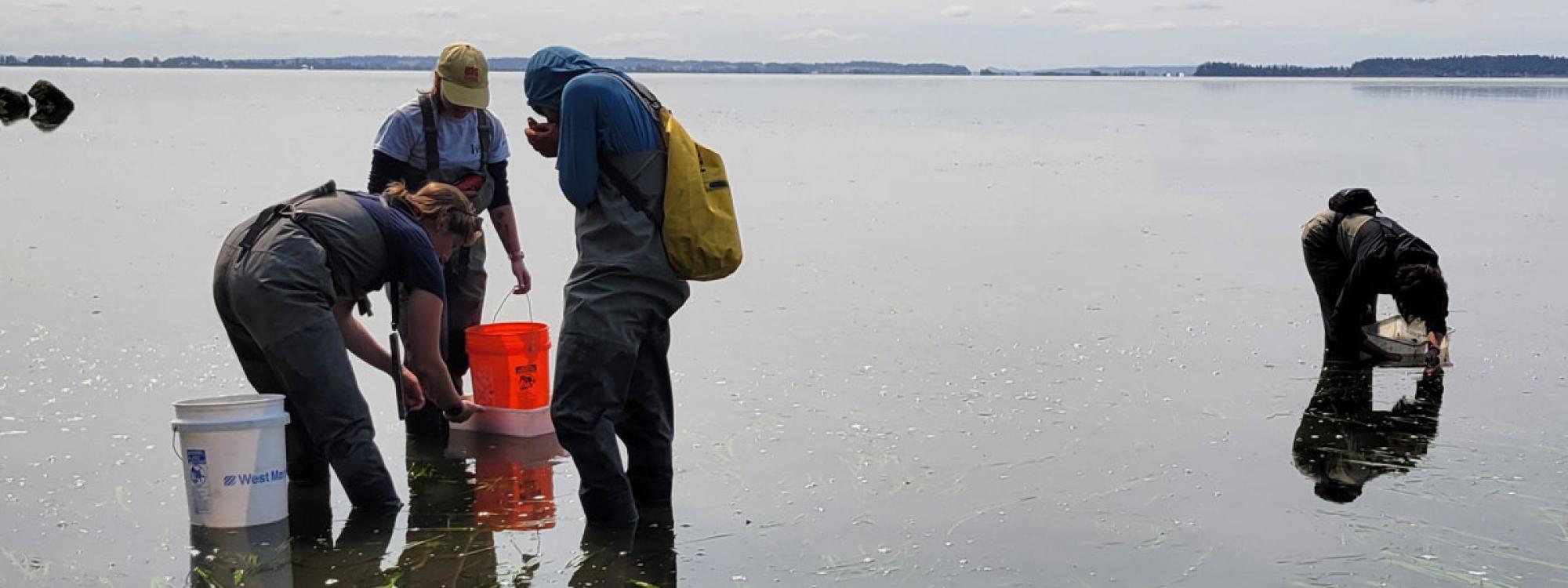
Written by guest contributors from Washington Conservation Corps (WCC): Cai Yan Leong, Julia Kaminski, Grayson Hayden, Luci Johnston, Chris Seymour
Why Green Crabs Matter in Puget Sound
European green crabs “green crab” are now a well-established invasive species in Washington State’s Puget Sound. Their native range stretches from the coast of northwestern Africa to northern Europe, including Iceland and the British Isles. They were introduced to the U.S. East Coast in the early 1800s by European settlers and have caused major ecological and economic damage. In recent years, green crab populations have continued spreading, disrupting ecosystems across the West Coast.
West Coast Establishment
The first well-established breeding population on the West Coast was discovered in San Francisco Bay between 1989 and 1990. Since then, the species has spread north into Washington and British Columbia. Within Puget Sound, one area of particular concern is Padilla Bay, home to an impressive 9,000 acres of crucial eelgrass habitat. The first confirmed detection of a green crab in Puget Sound was in Westcott Bay, San Juan Islands in 2016 .
Green crabs are generalists
Green crabs thrive in new environments because:
- They tolerate a wide range of temperatures, salinity levels and oxygen conditions.
- They eat many types of prey, which helps them thrive as invaders.
- Their foraging damages eelgrass beds and reduces habitat for juvenile fish, including native salmon.
- They feed on bivalves, such as mussels and oysters, that live burrowed in mud.
- Their digging and feeding can destabilize sediment banks, causing erosion and degrading habitat for many other species.
Because Padilla Bay holds the largest contiguous eelgrass bed in the lower 48 states, the presence of green crabs poses a serious risk to this critical habitat.
Impacts on habitat, culture, and economics
Destruction of eelgrass and shellfish habitat results in the loss of many culturally important first foods like salmon, clams, and oysters. These impacts extend to the Tribal and coastal communities harming both cultural practices and local economies. On the East Coast of North America, where the crabs are firmly established, they have greatly damaged commercial shellfish industries with losses estimated at more than $22 million per year.
What’s Being Done
State and federal agencies, Tribal nations, and local partners are working together to monitor green crab populations and reduce their impacts. Efforts include trapping, rapid response teams, citizen science monitoring, and habitat protection. Continued vigilance and community involvement are key to protecting Washington’s shorelines and the species that depend on them.
Looking ahead
European green crabs present a real threat to Puget Sound’s ecosystems, economies, and cultural traditions. Understanding their impacts, and supporting ongoing monitoring and management efforts, helps safeguard the region’s vital eelgrass beds, shellfish resources, and salmon habitat for generations to come.
How You Can Help
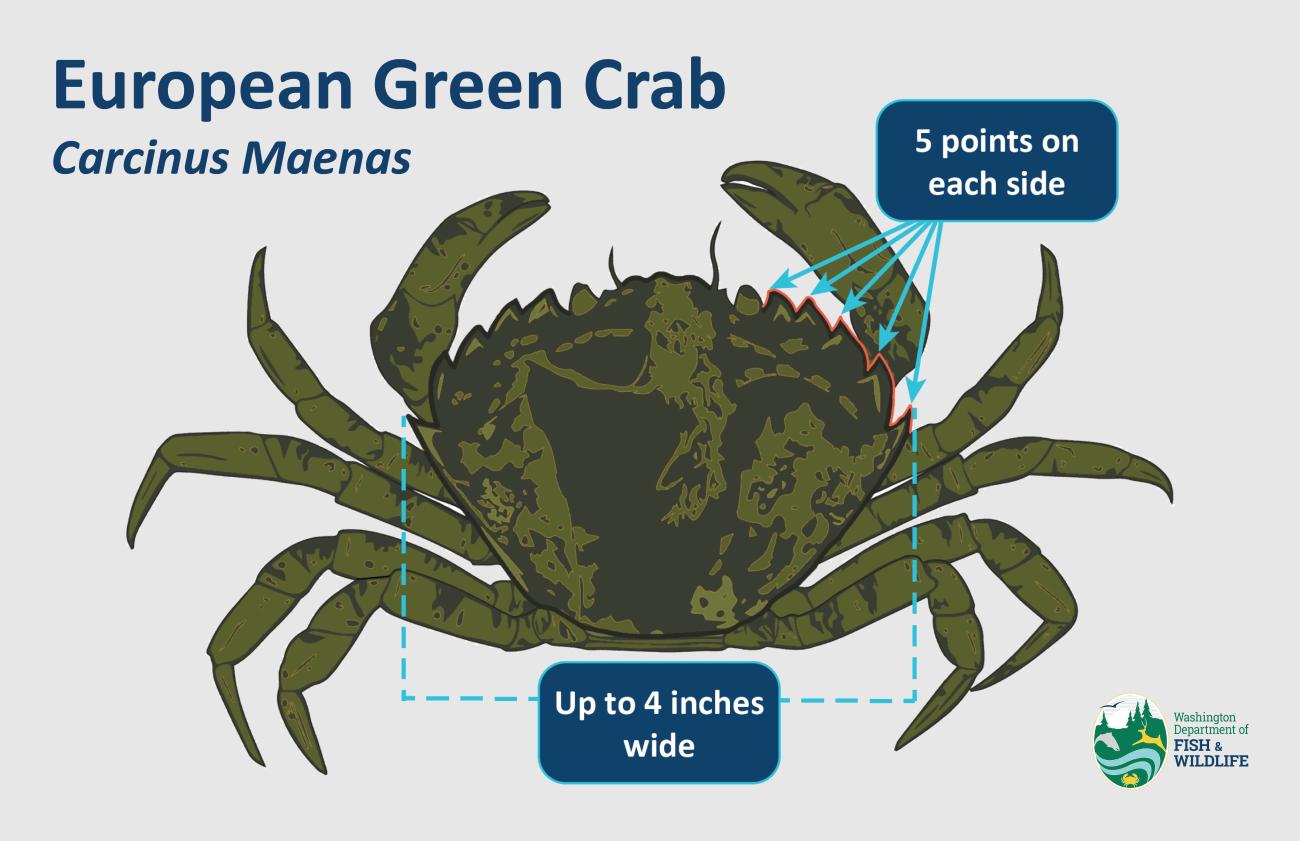
Community reporting plays an important role in tracking and managing this invasive species. Despite their name, green crabs are not always green, they may appear yellow or red.
Key identification features
- A diamond‑shaped shell
- Five sharp spines on each side of the eyes
- Three bumps between the eyes (rostral bumps)
If you encounter a potential green crab
- DO NOT KILL IT! Misidentifications are common, and harming native crabs is a serious risk.
- DO NOT TRANSPORT IT! Possession is illegal without a permit.
- REPORT IT! Washington Department of Fish and Wildlife or call the WDFW Aquatic Invasive Species hotline at 1‑888‑933‑9247.
Additional Resources
References
Dunagan, C. (2016, August 2). Green crabs could impair Puget Sound shellfish operations | Encyclopedia of Puget Sound. https://www.eopugetsound.org/magazine/invasive-green-crabs
Dunagan, C. (2025, August). Ten years of confronting a costly green crab invasion in Puget Sound | Encyclopedia of Puget Sound. https://www.eopugetsound.org/magazine/ten-years-of_confronting-a-costly-green-crab-invasion
Young, A. M., & Elliott, J. A. (2020). Life History and Population Dynamics of Green Crabs (Carcinus maenas). Fishes, 5(1), 4. https://doi.org/10.3390/fishes5010004